




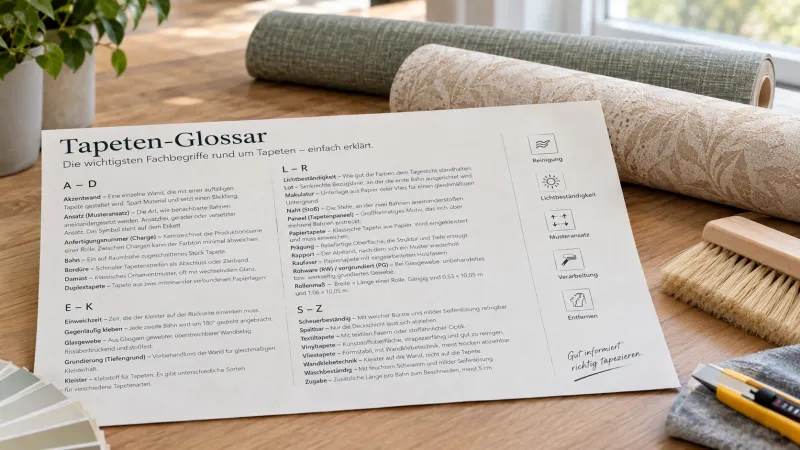
Pattern repeat, match, batch, duplex: when buying wallpaper you come across many technical terms. This glossary explains the most important ones briefly and clearly, grouped by topic.
Wallpaper types and materials
Non-woven wallpaper – wallpaper on a base of cellulose and textile fibres. Dimensionally stable, hung using the paste-the-wall method and usually strippable dry. A comparison of wallpaper types can be found in the article Non-woven, paper or glass fabric.
Paper wallpaper – classic wallpaper made of paper. It is pasted and must soak; it expands when pasted.
Duplex wallpaper – wallpaper made of two bonded paper layers. When removing it, the top layer can often be peeled off.
Vinyl wallpaper – wallpaper with a plastic surface, usually on a non-woven or paper backing. Hard-wearing and easy to clean.
Textile wallpaper – wallpaper with a surface of textile fibres or with a fabric-like look.
Woodchip wallpaper – paper wallpaper with embedded wood fibres, which is painted.
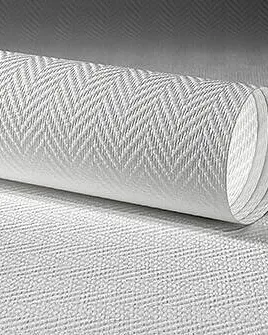
Glass fabric (glass fibre wallcovering) – a paintable wallcovering woven from glass yarn. Crack-bridging and impact-resistant, also available as a non-combustible version (A2). More in the glass fibre wallcovering guide.
Raw (RW) / pre-primed (PG) – for glass fabric: untreated fabric or factory-primed fabric that absorbs less paint.
Lining paper – a paper or non-woven base hung before the actual wallpaper to create an even surface.
Pattern, design and quantity
Pattern repeat – the distance in centimetres after which a pattern repeats. The larger the repeat, the more waste. See How many rolls of wallpaper do you need?.
Pattern match – the way neighbouring strips are hung so that the pattern continues: free match, straight or offset match. The symbol is on the label; see Wallpaper symbols explained.
Reverse hanging – every second strip is hung turned by 180 degrees to even out small colour differences between the edges.
Damask – a classic ornamental pattern originating from weaving, often with alternating sheen. Typical of Italian collections such as Tradizione Italiana.
Panel (wallpaper panel) – a large motif spanning several strips that works like a picture on the wall, for example in the Project II collection.
Embossing – a relief-like surface that creates texture and depth, for example on fabric-like luxury wallpapers.
Feature wall – a single wall decorated with a striking wallpaper while the other walls stay calm. Saves material and creates a focal point.
Border – a narrow strip of wallpaper used as a finish or decorative band, for example below the ceiling.
Batch number – identifies the production run of a roll. The shade can vary slightly between batches, so only use rolls from the same batch for one room.
Roll dimensions – width × length of a roll. Common sizes are 0.53 × 10.05 m and 1.06 × 10.05 m; some collections have different dimensions.
Strip – a piece of wallpaper cut to room height. Depending on the room height and the repeat, one roll usually gives three to four strips.
Allowance – extra length per strip for trimming at ceiling and skirting board, usually about 5 cm at the top and bottom.
Hanging
Paste the wall – the paste is applied to the wall instead of the wallpaper. Standard for non-woven wallpapers.
Soaking time – for wallpapers that are pasted, the time the paste must act on the back before the strip goes on the wall.
Wallpaper paste – adhesive for wallpaper. There are different types for paper, non-woven and heavy wallpapers; a special glass fabric adhesive is used for glass fabric. The information on the label is decisive.
Primer (deep primer) – pre-treatment of very or unevenly absorbent walls so that the paste holds evenly.
Plumb line – a vertical reference line along which the first strip is aligned. Walls and corners are rarely exactly vertical.
Seam (butt joint) – the point where two strips meet. Non-woven wallpapers are hung butt-jointed, i.e. edge to edge without overlap.
Properties and care
Washable – cleaning level: light dirt can be removed with a damp sponge and a mild soap solution.
Scrubbable – cleaning level: the surface can be cleaned with a soft brush and a mild soap solution.
Lightfastness – how well the colours of a wallpaper withstand daylight; indicated by sun symbols.
Peelable – when removing, only the top layer comes off; a backing layer stays on the wall.
Leave a Comment