




Every wallpaper label carries small symbols. They reveal how hard-wearing the surface is, whether the colours hold in sunlight, how the strips are matched and how the wallpaper can be removed later. If you read these signs before buying, you avoid the most common wallpapering mistakes. Here you will find all the important symbols and what they mean.
Cleaning: how much water can the wallpaper take?
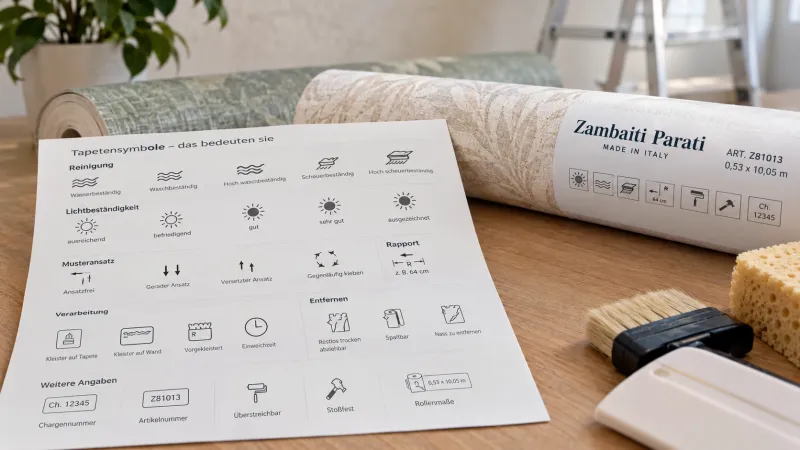
The cleaning symbols show waves – and on the most robust wallpapers a brush as well. The more, the tougher the surface:
- Spongeable (one wave): fresh paste stains can be dabbed off with a damp sponge. Not for regular cleaning.
- Washable (two waves): light dirt can be removed with a damp sponge and a mild soap solution.
- Super washable (three waves): tolerates more frequent damp wiping.
- Scrubbable (wave with brush): can be cleaned with a soft brush and a mild soap solution.
- Super scrubbable (several waves with brush): the toughest level – for kitchens, hallways, children's rooms and commercial spaces.
For heavily used rooms we recommend at least "washable", for kitchens and hallways "scrubbable".
Lightfastness: will the wallpaper fade?
Sun symbols show how well the colours withstand daylight. The scale runs from "moderate" through "satisfactory" and "good" to "very good" and "excellent lightfastness". The more complete the sun symbol, the more colour-stable the wallpaper. In rooms with large windows or facing south, high lightfastness is worthwhile – otherwise sunny parts of the wall fade visibly faster than the rest.
Pattern match: how do the strips fit together?
- Free match (arrow with a zero): the pattern does not need matching, strips can be hung side by side in any order. Least waste.
- Straight match (two arrows at the same height): every strip starts at the same point of the pattern.
- Offset match (two arrows staggered): every second strip is shifted by half a repeat. Slightly more waste.
- Reverse hanging (two arrows pointing in opposite directions): every second strip is hung turned by 180 degrees. This evens out slight colour differences at the edges and is required for some plain and textured wallpapers.
Next to the symbol is the pattern repeat in centimetres – the distance after which the pattern repeats. It decides the number of rolls; exactly how is shown in the article How many rolls of wallpaper do you need?.
Application: where does the paste go?
- Paste the paper: the back of the strip is pasted and must soak for a certain time before it goes on the wall. Typical of paper wallpapers.
- Paste the wall: the wall is pasted and the dry strip is hung. Typical of non-woven wallpapers – faster and cleaner. Instructions can be found under How to hang non-woven wallpaper.
- Pre-pasted: the adhesive is already on the back and is activated with water.
- Soaking time: for wallpapers that are pasted, the soaking time in minutes is often given as well.
Removal: how will the wallpaper come off later?
- Dry strippable: the strip can be peeled off dry in one piece. Typical of non-woven wallpapers.
- Peelable: only the top layer peels off, a paper layer stays on the wall and can serve as a base for the next wallpaper.
- Wet removable: the wallpaper must be soaked and scraped off.
More in the article How to remove old wallpaper.
Other information on the label
- Batch number: rolls with the same number come from the same production run. Only use rolls with the same number for one room.
- Article number: identifies design and colour – with Zambaiti Parati for example "Z81013".
- Overpaintable (brush or roller symbol): the wallpaper may be painted, such as glass fabric.
- Impact-resistant (hammer symbol): the surface is particularly resistant to mechanical stress.
- Roll dimensions: width and length of the roll, e.g. 0.53 × 10.05 m.
Frequently asked questions
What does "scrubbable" mean in everyday life?
The surface can be cleaned with a soft brush and a mild soap solution without being damaged. That is the right choice for kitchens, hallways and children's rooms.
Why should some wallpapers be hung in reverse?
With some plain and textured wallpapers, tiny colour differences between the left and right edge occur in production. If every second strip is turned, identical edges always meet and the seam does not show.
Where do I find the symbols when buying online?
In the product description and on the roll label. For questions about a specific item, write to us via WhatsApp at +49 178 265 93 11.
Leave a Comment