




Glass fibre wallcovering – also called glass fabric or glass tissue – is the technical sister of classic wallpaper. It is woven from glass yarn, glued to the wall and then painted. The result is a surface that withstands far more than paint on plaster. Here you will learn what glass fibre wallcovering can do, where it makes sense and what to consider when choosing and applying it.
What is glass fibre wallcovering?
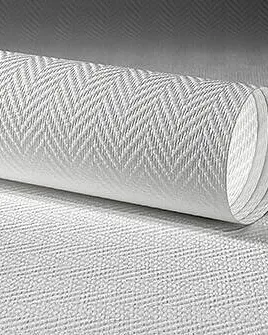
Glass fibre wallcovering consists of fine glass threads woven into a fabric with a particular texture – for example twill, diamond, herringbone or coarse weaves. After hanging it is painted with wall paint. The texture remains visible under the paint and gives the wall its character; the paint determines the colour.
Unlike non-woven or paper wallpaper, glass fabric is not a finished, printed surface but a reinforcing and textured covering that is only completed by painting.
The most important properties
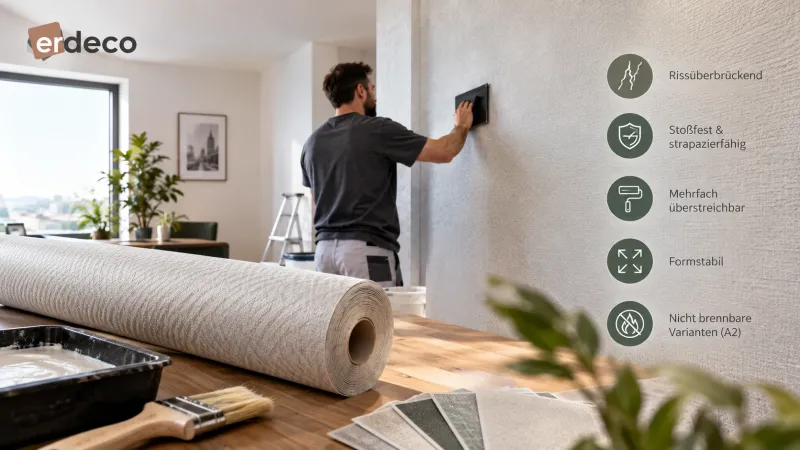
- Crack-bridging: the fabric bridges fine hairline cracks in the plaster and stops them from showing through to the surface.
- Impact-resistant and durable: the surface copes with knocks from furniture, bags or trolleys better than paint alone.
- Can be repainted many times: instead of re-papering, you simply repaint when you change colour. The texture remains.
- Dimensionally stable: glass fabric neither stretches nor shrinks – the seams stay closed.
- Non-combustible versions: there are glass fabrics classified as non-combustible (see below).
Where is glass fibre wallcovering worthwhile?
Wherever walls are heavily used or the surface needs to last a long time:
- Stairwells, corridors and entrance areas
- Medical practices, clinics, care facilities
- Hotels, offices and restaurants
- Schools, nurseries and public buildings
- Living spaces with cracked or uneven plaster
For renovating damaged walls there are dedicated systems such as SYSTEXX Active RENO, aimed at a fast, smooth renovation without extensive filling.
Fire protection: "non-combustible" to EN 13501-1
In Europe the fire behaviour of building materials is classified according to the standard EN 13501-1. Class A2 stands for "non-combustible". For escape routes, public buildings or properties with fire safety requirements, such a classification may be required.
In our range you will find these products in the category Non-combustible glass fibre wallcoverings (A2). Which class is required in your building is set by its fire safety concept – for commercial projects, clarify this in advance with the architect or fire safety planner. The exact classification of each product is stated in its technical data sheet.
Acoustics and heat
Besides classic textured fabrics there are systems with added functions. SYSTEXX AcousTherm combines the wall surface with acoustic and thermal insulation – interesting for offices, meeting rooms, restaurants and living spaces with cold exterior walls.
Raw or pre-primed?
You will often see two abbreviations in the product name:
- RW – raw material: the fabric comes untreated. It absorbs more paint with the first coat.
- PG – pre-primed: the fabric is primed at the factory and therefore absorbs less paint.
Both versions are painted after hanging. How many coats are needed and which paint is recommended is stated in the technical data sheet of the product.
Application in brief
- Surface: sound, dry, clean. Prime very absorbent surfaces first.
- Adhesive: glass fabric is applied with a special glass fabric adhesive (dispersion adhesive), not with normal wallpaper paste. The adhesive is applied to the wall.
- Hanging: hang strip by strip butt-jointed and press it bubble-free with a plastic spatula. Mind the correct side – on most fabrics it is marked on the roll.
- Let it dry and only then paint.
- Painting: with the paint and number of coats given in the data sheet.
Protection when cutting: cutting can release fine glass fibres that irritate the skin. Wear gloves and long sleeves and use a sharp knife.
Single roll instead of a pallet
In the trade, glass fabric is often only sold by the pallet. For smaller areas and repairs, many items are available in our single-roll sale. Patterned fabrics for a decorative effect can be found in the SYSTEXX Phantasy Design Collection.
Glass fibre or non-woven wallpaper?
If the wall should above all be beautiful and patterned, a printed non-woven wallpaper is the right choice. If it must above all be robust, paintable or suitable for fire protection, there is a lot to be said for glass fabric. A detailed comparison can be found in the article Non-woven, paper or glass fabric.
Frequently asked questions
Can glass fibre wallcovering be removed again?
Yes, but with more effort than non-woven wallpaper, because the fabric and adhesive are firmly bonded to the wall. For most areas of use, exactly this durability is the reason to choose glass fabric.
How often can glass fibre wallcovering be repainted?
Many times. With each coat the texture becomes a little softer but remains visible. This is one of its main advantages over wallpapers that have to be replaced every time the colour changes.
Which glass fibre wallcovering is suitable for stairwells?
Durability and often fire protection are required here. Check whether a non-combustible class is required in your building – then choose from the category non-combustible (A2). For questions about a specific project, reach us via WhatsApp at +49 178 265 93 11.
Leave a Comment