




Three material classes, three use cases
Choosing wallpaper works best in a specific order: pick the backing material first, the design second. It sounds unromantic, but it prevents the two most expensive mistakes — buying a material that does not suit the surface, and underestimating how much of it you need.
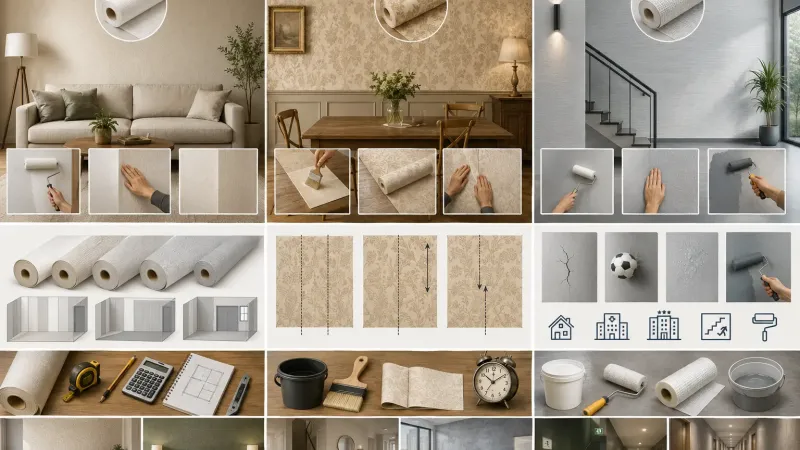
In practice the choice comes down to three classes: non-woven, paper and glass fibre. Each has a clear place.
| Criterion | Non-woven | Paper | Glass fibre |
|---|---|---|---|
| Where paste goes | on the wall | on the drop, with soaking time | on the wall (special adhesive) |
| Dimensional stability | does not expand | expands and shrinks | fully stable |
| One-person job | yes | difficult | yes, with practice |
| Removal | peels off dry | soak and scrape | permanent |
| Repaintable | limited | limited | up to ten times |
| Typical service life | 10–15 years | 7–10 years | 30 years and beyond |
Non-woven: the default for living spaces
Non-woven wallpaper has largely replaced paper in residential use, and the reason is one technical property: the backing is made of compressed cellulose and textile fibres that do not swell when wet. Everything else follows from that.
Because the material stays dimensionally stable, paste is applied directly to the wall. The dry drop goes on top and can still be slid into position for several minutes until the pattern lines up. No soaking time, no pasting table, and no risk of open seams — the classic failure of paper, which shrinks slightly as it dries.
The second advantage appears years later. Non-woven usually strips off dry, often in full lengths. Anyone who has removed old paper wallpaper with a steamer and a scraper knows exactly how much of a weekend that saves.
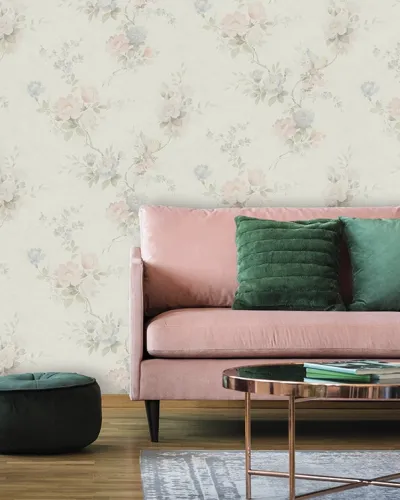
Choose non-woven for: living rooms, bedrooms, hallways, children's rooms — any room with normal wear. That covers most jobs.
Glass fibre wallpaper: when the wall has to work
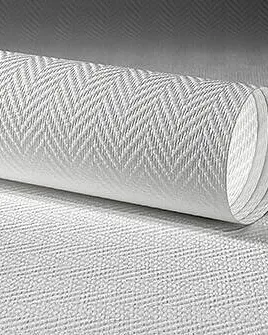
Glass fibre wallpaper — also called glass cloth or fibreglass wallcovering — is a woven textile made from glass filaments. Nobody chooses it for the pattern. It is chosen for what it does mechanically.
The weave bridges hairline cracks in the plaster and stops them from opening further. In new buildings that are still settling, and in older properties with a substrate that moves, this is often the deciding factor. Impact resistance is the second reason: in stairwells, clinics, hotels and offices, a glass fibre wall lasts decades where paper shows damage along the edges within two years.
Third is fire behaviour. Glass fibre is mineral and does not burn. In escape routes and public buildings that is frequently a requirement rather than a preference.
Glass fibre is painted after hanging, and repainted several times over its life. A wall can change colour every few years without ever being stripped again. After roughly ten coats the paint fills the weave and the texture disappears — that is the practical end of its life.
The trade-off to understand: glass fibre bonds permanently to the substrate. It cannot realistically be removed without damaging the wall. If you might want a patterned wallpaper again in five years, this is the wrong choice.
Choose glass fibre for: commercial spaces, stairwells, rental properties with high turnover, crack-prone substrates, rooms with fire regulations.
Paper: not obsolete, just specialised
Paper wallpaper has not been superseded — it has been narrowed to where it belongs. Hand-printed designs, historical reproductions and many small-batch collections exist only on paper, because the printing process requires it. Anyone restoring a listed building or after a particular studio design will end up here.
It rewards care. Every drop is pasted, folded and left to soak — and every drop for exactly the same length of time, otherwise the sheets expand differently and the seams open. This is craft work, and normally a two-person job.
Roll widths: why 53, 70, 100 and 106 cm
Roll width affects both material consumption and working time, and it is the figure most often assumed rather than checked.
- 53 cm — the European standard, usually 10.05 m long. Most collections.
- 70 cm — an intermediate format used by several Italian collections. Fewer seams per wall.
- 100 cm — the usual width for glass fibre, generally on 25 or 50 metre rolls.
- 106 cm — double standard width. Halves the number of seams, but needs two people to hang.
A worked example: a room with a 12 m perimeter and 2.50 m ceilings needs 23 drops at 53 cm, but only 12 at 106 cm. That is eleven fewer seams — and eleven fewer chances of a visible joint.
The width is stated in the product details of every article. Calculating with the default assumption of 53 cm when the roll is actually 70 cm wide means ordering roughly a third too much.
Pattern repeat: the most common miscalculation
The repeat is the vertical distance after which the design starts again. It determines waste, and therefore the real quantity needed.
With a free match there is no pattern to align. Each drop is cut to ceiling height plus trim allowance, and waste stays minimal.
With a straight match the motif sits at the same height on adjacent drops. Each drop is rounded up to the next full multiple of the repeat.
With an offset match the neighbouring drop is shifted by half a repeat. Waste is highest here.
The scale of it: with a 2.50 m ceiling and a 64 cm repeat, every drop is cut to 3.20 m. That is 70 cm of waste per drop — across 23 drops, more than 16 metres of wallpaper, or about one and a half rolls that nobody budgets for when working from square metres alone.
If you would rather not do the arithmetic, our free wallpaper calculator accounts for roll width, repeat, match type and waste, and returns the number of rolls directly. No registration required.
Zambaiti Parati: Italian wallcoverings from Albino
Zambaiti Parati, based in Albino in the province of Bergamo, is among the best-known Italian manufacturers of high-end wallcoverings. The company combines traditional Italian design work with digital printing technology and produces entirely in Italy.
What sets the collections apart are material effects rarely found in mass-market ranges: textile surfaces with genuine relief, metallic effect pigments, silk and linen appearances, embossed finishes with visible depth. The Savana series, for instance, uses woven-fabric structures that read as stretched textile from a metre away.
Zambaiti Parati also produces licensed collections for established fashion houses — designs that translate couture vocabulary into wall design.
Roll widths vary by collection between 53 and 106 cm, which makes checking the product details particularly worthwhile before calculating quantities.
Vitrulan SYSTEXX: glass fibre from Germany
A significant share of the glass fibre wallcovering used across Europe comes from Vitrulan in Upper Franconia, Germany. SYSTEXX is the brand under which its glass textiles are supplied.
The practically important distinction within the range is pre-treatment. Raw white material is hung and then painted. Pre-coated material already carries a primer, saves one coat and produces a more even final surface, at a somewhat higher material cost.
Both are mineral, non-combustible and normally supplied at 100 cm width. Textures run from fine linen weaves to pronounced graphic reliefs.
The decision in three questions
1. How long should the wall last?
Under ten years: non-woven. Over twenty, or commercial use: glass fibre.
2. Is the substrate moving?
New build still settling, visible hairline cracks, older plaster that works: glass fibre. Stable and dry: non-woven.
3. Is the design the point?
If a specific pattern is driving the decision, the material follows the design — and the question usually answers itself, because the design will only be offered on one backing.
Common questions
Can non-woven wallpaper be painted over?
Textured, unprinted non-woven, yes. Printed decorative papers can technically be painted, but lose the surface effect that justified their price — rarely worth it.
How much paste is needed?
As a rule of thumb, a 200 g pack covers roughly 30 m² of non-woven or 25 m² of paper. The exact figure is on the packaging and depends on how absorbent the surface is; highly absorbent walls should be primed first. Glass fibre requires a dedicated adhesive.
Why should all rolls come from one batch?
Slight colour variation can occur between production batches. It is invisible on the roll and obvious on the wall. The batch number is printed on every label. When in doubt order one roll more — a roll ordered later will almost certainly come from a different batch.
Is glass fibre suitable for private homes?
Technically yes, and in the hallways and stairwells of apartment buildings it is often the more economical choice. In living and sleeping areas, the fact that it cannot be removed usually argues against it.
Advice
Erdeco Wanddesign stocks over 1,200 wallpapers from Italian and European manufacturers, including collections by Zambaiti Parati and SYSTEXX glass fibre by Vitrulan. We are a specialist business based in Neckarsulm, Germany, and we do not only sell these materials — we install them. The notes in this article come from site experience rather than from a manufacturer's brochure.
If you are weighing up two materials, or unsure about a particular substrate, we are happy to advise. Samples are available on request.
Leave a Comment